In today's tutorial, I'm going to give you some tips on removing masking fluid and next time we'll look at some of the alternate approaches to masking -- including unusual uses of the fluid and use of masking films. (If you want to review the first posts in this series, go back here and here!!)
Before removing the masking fluid, it's a good idea to clean off as much of the residual paint on the surface of the masking as possible so you don't rub dried paint onto your paper as you work. You can use a damp tissue for the larger areas and a damp cotton swab for smaller places.
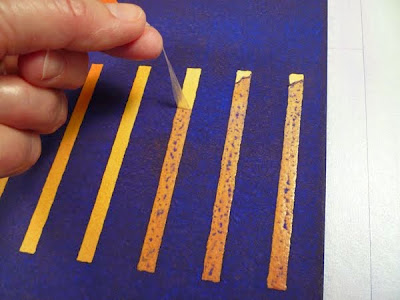
In the image above, I'm removing a section of masking fluid with a rubber cement pickup -- basically a little square of crepe shoe sole material. I rub it lightly at the edge of the masked area to grab the masking and pull gently away from the paper. This works especially well with Winsor Newton masking fluid because it forms a relatively thin film. With the heavier masking fluids such as Incredible White Mask and Pebeo, you can start lifting the film with the pickup and then pull on it with your fingers to remove it in strips or sheets (this also works with the Winsor Newton). Below, you see me pulling the masking off by hand after getting each row started with the pickup tool. I carefully grab the rolled edge left by the pickup and tug gently.
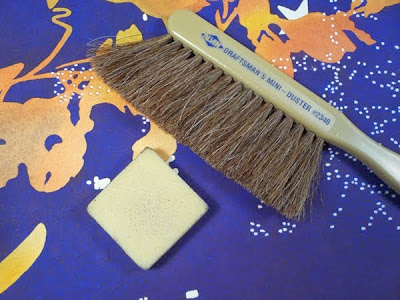
 If you have very small areas of masking fluid, such as the dots I used on this painting, you can either rub over them gently with the pickup tool or use your fingers to loosen them. You must clean the edge of the pickup or wipe your fingers frequently so you don't smear paint onto the newly uncovered areas as you work. I find it helps greatly to brush the surface afterwards with a drafting brush to remove all the loose bits. That won't mar your paint surface or rub paint into the reserved areas.
 At the end of this process, you need to "pat down" the painting to make sure you've removed all the masking fluid. Run your hands lightly across the surface to detect any missed spots.
In my last tutorial, I mentioned that I had read that you shouldn't shake the bottle of masking fluid because it causes the latex to clump, but I couldn't recall where I'd found that information. Reader Kristen Colebank pointed out that Elizabeth Kincaid discusses this in her book Paint Watercolors that Dance with Light (North Light Books). Although I only recently purchased a copy of Elizabeth's book, I suspect that I may have looked through it at some point and that it was the source I remembered. Thanks, Kristen!!
I hope you're enjoying these posts. I recently saw a comment from an artist asking why we artists spend so much time on technique instead of talking about ideas. I've been thinking about that ever since and have to answer that without a solid grounding in technique, all the fabulous ideas in the world are just elusive mists. The goal is to reach a point where the technique becomes so integrated into your process that it becomes second nature. I hope I'm helping you proceed in that direction!!
At the end of this process, you need to "pat down" the painting to make sure you've removed all the masking fluid. Run your hands lightly across the surface to detect any missed spots.
In my last tutorial, I mentioned that I had read that you shouldn't shake the bottle of masking fluid because it causes the latex to clump, but I couldn't recall where I'd found that information. Reader Kristen Colebank pointed out that Elizabeth Kincaid discusses this in her book Paint Watercolors that Dance with Light (North Light Books). Although I only recently purchased a copy of Elizabeth's book, I suspect that I may have looked through it at some point and that it was the source I remembered. Thanks, Kristen!!
I hope you're enjoying these posts. I recently saw a comment from an artist asking why we artists spend so much time on technique instead of talking about ideas. I've been thinking about that ever since and have to answer that without a solid grounding in technique, all the fabulous ideas in the world are just elusive mists. The goal is to reach a point where the technique becomes so integrated into your process that it becomes second nature. I hope I'm helping you proceed in that direction!!
Yesterday's post on watercolor masking fluid generated a lot of interest and feedback. Lots of strong feelings out there on the subject -- particularly when it comes to the brand!! I decided this topic deserved a little more airtime.
I've been using masking fluid since I returned to watercolor 15 years ago -- starting with very experimental spattering techniques and eventually moving to controlled use to preserve whites or to allow me to create background washes around complicated shapes. Although some artists use frisket film in combination with the fluid, I have always coated all masked areas with fluid to make sure all surfaces behave the same after I remove the masking and start adding paint. I use a variety of masking fluids and tools to accomplish my goals, as you can see in the photo above.
You can see the various masking fluids I use, brushes (a size 2 and size 6 are all I need), my bucket of soapy water and the little container of liquid dish soap, the sharpened wooden handle of an old cheap brush, a toothbrush for spattering, a ruling pen, and a couple of different nibs.
Inexpensive white synthetic brushes seem to work best with masking fluid. (Whatever you do, do not use a fine watercolor brush to apply it.) Yesterday's post includes information on how I keep the brushes in good condition. Although I've never tried it, some people use Goo Gone or other solvents to rescue clogged brushes.
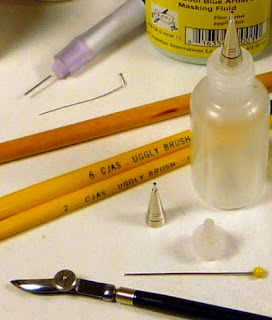 The supernib plus from Masquepen is in the upper left of this closeup photo, along with the fine pin they include to help clean it. At middle right is a bottle marketed by Jacquard for silk painting -- three different nibs are available and what is shown is the mid-size one. The metal nib screws onto the little plastic spout which pops into the bottle top. When I'm using this, I put the straight pin into the nib to keep it open when I take a break. These nibs seem to work best with slightly thicker-bodied fluids -- Pebeo and Incredible White Mask -- and are fairly easy to clean because of the short tip.
The ruling pen, shown at the bottom of the photo, can be adjusted to give lines of varying widths. I find the Winsor Newton fluid works best because it flows easily. A line width of about 1mm seems to be best for outlining rectilinear shapes. You can also create finer lines for special things like cat whiskers or tiny plant hairs, but it's difficult to make very thick lines because the pen doesn't hold enough fluid to go very far. This tool is very easy to clean by wiping it thoroughly and/or peeling off any dried masking. You can go here, here, or here to find ruling pens.
I got an Incredible Nib with my first purchase of Incredible White Mask, but I've never found it to be useful.
Don't buy large quantities of masking fluid unless you're planning some big projects. Pebeo tends to seize up in the bottle over time and Incredible White Mask can be difficult to remove if it's old when applied, even if you don't leave it on the paper very long. A sign that it's too old is the color -- when fresh it's the color of cream, and it gets very yellowed when old. Although I don't always remember to do this, it's a good idea to date your bottle when you buy it.
Slightly thickened masking fluid can be thinned with a very small amount of plain ammonia. I always stir the fluid rather than shaking it, after reading some years ago that shaking caused the latex particles to clump and separate out of solution, making the stuff useless. Yet several manufacturers instruct you to shake the masking fluid before using. Although I often save technical information, I can't find the article I read. If anyone has more information on this matter, please leave a comment.
Masking fluid must be applied to perfectly dry paper and your painting must also be perfectly dry before you remove the masking. You can remove it with your fingers or with a rubber cement pickup (a small square that looks like a piece of a crepe sole) if there's a large amount to remove.
After removing the mask, you'll have bright white shapes with hard edges. It's this characteristic that leads many watercolorists to reject the use of masking fluid. However, by softening the edges and/or painting in the shapes, you can integrate them and create an esthetically pleasing painting. But that's a topic for another day!!
The supernib plus from Masquepen is in the upper left of this closeup photo, along with the fine pin they include to help clean it. At middle right is a bottle marketed by Jacquard for silk painting -- three different nibs are available and what is shown is the mid-size one. The metal nib screws onto the little plastic spout which pops into the bottle top. When I'm using this, I put the straight pin into the nib to keep it open when I take a break. These nibs seem to work best with slightly thicker-bodied fluids -- Pebeo and Incredible White Mask -- and are fairly easy to clean because of the short tip.
The ruling pen, shown at the bottom of the photo, can be adjusted to give lines of varying widths. I find the Winsor Newton fluid works best because it flows easily. A line width of about 1mm seems to be best for outlining rectilinear shapes. You can also create finer lines for special things like cat whiskers or tiny plant hairs, but it's difficult to make very thick lines because the pen doesn't hold enough fluid to go very far. This tool is very easy to clean by wiping it thoroughly and/or peeling off any dried masking. You can go here, here, or here to find ruling pens.
I got an Incredible Nib with my first purchase of Incredible White Mask, but I've never found it to be useful.
Don't buy large quantities of masking fluid unless you're planning some big projects. Pebeo tends to seize up in the bottle over time and Incredible White Mask can be difficult to remove if it's old when applied, even if you don't leave it on the paper very long. A sign that it's too old is the color -- when fresh it's the color of cream, and it gets very yellowed when old. Although I don't always remember to do this, it's a good idea to date your bottle when you buy it.
Slightly thickened masking fluid can be thinned with a very small amount of plain ammonia. I always stir the fluid rather than shaking it, after reading some years ago that shaking caused the latex particles to clump and separate out of solution, making the stuff useless. Yet several manufacturers instruct you to shake the masking fluid before using. Although I often save technical information, I can't find the article I read. If anyone has more information on this matter, please leave a comment.
Masking fluid must be applied to perfectly dry paper and your painting must also be perfectly dry before you remove the masking. You can remove it with your fingers or with a rubber cement pickup (a small square that looks like a piece of a crepe sole) if there's a large amount to remove.
After removing the mask, you'll have bright white shapes with hard edges. It's this characteristic that leads many watercolorists to reject the use of masking fluid. However, by softening the edges and/or painting in the shapes, you can integrate them and create an esthetically pleasing painting. But that's a topic for another day!!


